
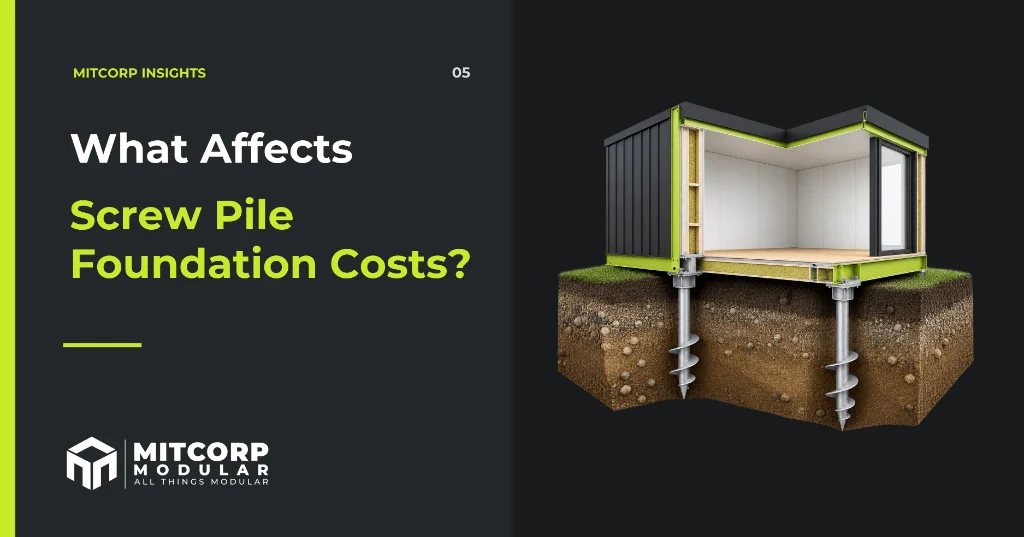
There is no reliable standard price for screw-pile foundations without knowing the building, ground conditions and site access. A low price per pile can sound attractive, but it does not tell you the installed cost of a complete, engineered foundation.
For a useful quotation, the supplier needs to understand what the piles will support, how loads will be transferred and what installation conditions are likely to be found.
What are screw piles?
Screw piles are steel shafts fitted with helical plates. They are installed into the ground using rotational force until the required design performance is achieved. The building is then supported through a designed connection between the piles and its structural frame.
They can reduce excavation, spoil removal and concrete use on suitable sites. Installation can also be quick because there is no concrete curing period. Suitability must still be confirmed by design and site assessment.
Why online prices vary so widely
Published figures often describe different things. One may be the supply price of a small pile, another an installation rate, and another a full foundation package. Comparing them without checking the scope is misleading.
The total cost can include:
- site assessment and ground information;
- structural and foundation design;
- the number, diameter, length and grade of piles;
- extensions, brackets and connections;
- installation plant and labour;
- mobilisation and travel;
- load or integrity testing where required;
- dealing with obstructions or unexpected ground; and
- the supporting frame or ground beams above the piles.
That is why MITCORP does not publish a universal “per pile” project price.
The main cost factors
Building size and loads
A small garden room and a residential annexe place very different demands on the foundation. The structural design determines the number and capacity of piles required.
Ground conditions
Soft ground, made ground, clay, fill, groundwater, rock and buried obstructions can all affect the design and installation method. Ground information reduces uncertainty.
Depth and pile specification
The required bearing strata may be deeper than expected. Pile length, diameter, steel grade and corrosion allowance influence the cost.
Access
Restricted gardens, narrow routes, overhead cables, slopes and limited working space affect what equipment can be used and how efficiently installation can proceed.
Testing and certification
A permanent or habitable building may require calculations, installation records, torque data and testing to demonstrate that the foundation meets the design requirements.
Screw piles compared with concrete
Potential screw-pile advantages include:
- less excavation and spoil;
- reduced concrete use;
- rapid installation;
- no concrete curing delay;
- useful solutions for some sloping or restricted sites; and
- the possibility of removal or reuse in some applications.
Concrete or another system may be more appropriate where loads, obstructions, ground conditions or the wider building design make screw piles unsuitable.
The right comparison is between complete engineered solutions, not an individual pile and a complete concrete base.
What should a quotation include?
Ask whether the quotation covers:
- design responsibility and calculations;
- assumptions about ground conditions;
- the specified number and type of piles;
- installation and mobilisation;
- brackets, beams and structural connections;
- testing and records;
- exclusions and provisional sums; and
- what happens if obstructions or unsuitable ground are encountered.
Getting a project-specific cost
MITCORP can review the building, site and access before coordinating an appropriate foundation solution. Where screw piles are suitable, they can form part of the wider modular programme. Where they are not, we will explain the alternative rather than force the wrong system onto the project.
Read more about why modular construction works or request a project discussion.
Costs and suitability are project-specific. Foundation design should be based on the building loads, site conditions and appropriate professional input.
Frequently asked questions
Are screw piles cheaper than concrete?
Sometimes, but not automatically. Access, loads, ground conditions, testing and the complete supporting structure must be compared on the same scope.
How long do screw piles last?
Service life depends on the pile specification, ground conditions, corrosion design and installation. It should be addressed in the engineering design rather than assumed from a generic claim.
Can screw piles be used on every site?
No. Rock, obstructions, aggressive ground, loads or access constraints can make another foundation system more suitable.